R01
Recognize
Read the forces shaping the moment: online influence, peer status, masculine rules, family, and setting.
ASK YOURSELF
What else could be going on here?
A FRAMEWORK FOR THE HARD MOMENTS
Connection and accountability
belong together.
For the boy who shuts down. The one who pushes back. The moment that catches you off guard. READ helps adults respond with greater understanding, steadiness, and dignity.
Developed by Nick Breugom · For adults supporting boys & young men
The moment keeps moving.
Explore a move in the loop above.
Parenting · Education · Coaching · Mentorship · Youth work
Behaviour is information.
It is not the whole story.
And it is not an excuse.
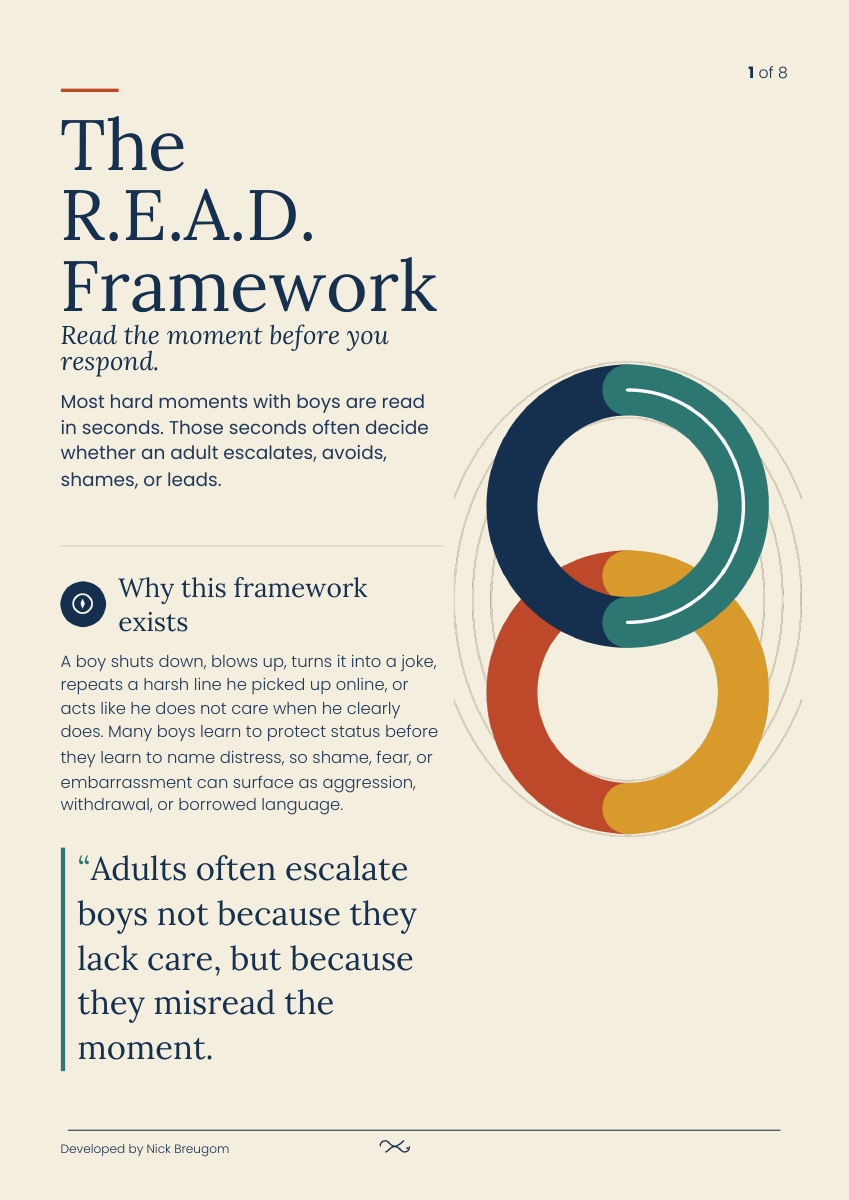
Under pressure, behaviour, meaning, harm, and response can collapse into one reaction. READ helps you separate them, so you can understand what is happening and still hold the line.
See what changes in practice ↗THE READ FRAMEWORK
Recognize and Examine help you read. Anchor is the hinge. Deliver is your response. Then notice what happens and return.
Read the forces shaping the moment: online influence, peer status, masculine rules, family, and setting.
What else could be going on here?
Read the behaviour as a signal, not a verdict. Aggression, withdrawal, or clowning may be covering something you have not yet understood.
What do I know, and what am I assuming?
Regulate yourself before you respond. Notice your own urgency, settle your tone, and make room for a deliberate response.
How can I bring steadiness to this?
Correct without shame. Name the behaviour and harm, hold the boundary, set the expectation, and keep a path open for repair.
How can I be clear and preserve dignity?
New information, a change in the group, or your own rising frustration may change what the moment needs.
A threat, disclosure, violence, or safety concern calls for action through the appropriate safeguarding, legal, or professional pathway. READ does not replace those responsibilities.
READ Framework · Developed by Nick Breugom · Introductory quick guide
AT HOME. AT SCHOOL. ON THE SIDELINE.
READ shapes how you enter the conversation, listen, and respond as you learn more. You can understand his side and still address what happened.
These imagined exchanges show one way that could unfold. Use your own words, and leave room for an answer you did not expect.
You hear your son call his younger brother “stupid” while they’re playing a video game. You’re tired, and your first thought is, “Why does everything have to turn into a fight?”
Recognize & Examine: You heard the insult, but missed what led up to it. There may be frustration, an argument about turns, or something else. Find out.
Anchor: Notice that you’re already arriving annoyed. Settle your voice and move closer, so you can help without shouting from the kitchen.
DELIVER, THEN LISTEN
YOU“Hey, let’s pause for a second. I heard the name-calling. What happened?”
HIM“He keeps grabbing the controller. I told him to stop!”
YOU“Okay, he needs to ask before taking it. I’ll help with that. And we need to sort it out without calling him stupid.”
Read the response: You now know there is a boundary to address for both children. Help them sort out the controller, check how his brother is doing, and give them time to settle.
COME BACK TO THE HURT
“I get why you were annoyed. He was hurt by what you called him, too. What could you say to him now?”
Help him find words if he needs them. The aim is to repair what happened and practise asking for space, rather than rush through an apology.
During group work, a boy calls a girl in his group “useless.” His friends laugh. When you approach, he says, “It was just a joke.”
Recognize & Examine: There is an audience, someone has been put down, and you do not yet know how the group was working together. The laughter may make backing down harder.
Anchor: You can interrupt the harm calmly and save the longer conversation for a quieter moment. Avoid making him perform an explanation for the class.
ADDRESS IT IN THE MOMENT
YOU“I’m going to pause you there. Calling her useless isn’t okay. If the work isn’t going well, I can help you sort that out.”
HIM“But I’m doing everything!”
YOU“Okay, let’s look at how the work’s being shared. I want to hear from both of you.”
Read the response: His answer gives you something to explore, rather than a conclusion to accept. Check that she is okay and can speak without being interrupted. Address the work issue without treating it as a justification for the insult.
FOLLOW UP WITH HIM PRIVATELY
“I want you to tell me when the group isn’t working. We can deal with that. We also need to come back to what you said to her. How do you think that landed?”
Listen to his answer. Help him understand the impact if he dismisses it, agree on a meaningful way to make amends, and check what support she wants. Keep following up.
A player comes off the ice after a missed pass and starts yelling at a teammate. You feel your own frustration rising. You were about to criticize that play yourself.
Recognize & Examine: The game matters to him, his teammates are watching, and he may be embarrassed or frustrated. You saw the play from a different angle; leave room for his account.
Anchor: Let go of the speech you were about to give. Bring your voice down, interrupt the yelling, and allow time before discussing the play.
MAKE ROOM FOR HIM TO SETTLE
YOU“Come sit with me a second. I want to hear what happened, but we need to stop the yelling. Take a minute. I’m here.”
HIM, AFTER A MOMENT“I was wide open. He never passes to me.”
YOU“You were waiting for that pass and it didn’t come. I get why you’re frustrated. Let’s work out what happened. He still didn’t deserve to be yelled at.”
Read the response: If he is still too upset to listen, give him more time while keeping the bench calm. When he is ready, hear his view, check the teammate’s perspective, and work on the play.
KEEP REPAIR PART OF THE CONVERSATION
“What do you think you need to say to him about how you came at him?”
Help him work out how to repair it and communicate on the next shift. Follow through on both. Understanding his frustration does not make the teammate responsible for being yelled at.
THE PERSON BEHIND READ

Shaping the conversation on men & boys.
Creator of the READ Framework.
Nick Breugom works in family violence prevention, specializing in work with men and boys. His work centres on a question with consequences for families, schools, and communities: how do we help boys grow into men who can understand themselves, build healthy relationships, and take responsibility for their actions?
Drawing on direct experience in youth programming and individual support, Nick brings a practical perspective to conversations about masculinity, emotional literacy, and accountability. He advocates for prevention that starts early, in the everyday moments when boys learn what they are allowed to feel, how to handle conflict, and what strength is supposed to look like.
How do we respond when a boy’s behaviour is hurtful, defensive, or difficult to understand?
He created the READ Framework to help parents, educators, coaches, and mentors navigate those moments. Whether the challenge is a hurtful comment, an angry reaction, or a boy who has shut down, READ offers a structure for responding with curiosity, steadiness, and clear boundaries. It helps adults call boys into conversations about their behaviour, its impact, and what needs to happen next.
Nick’s contribution to the sector is grounded in a clear conviction: taking boys’ experiences seriously and holding them accountable belong in the same conversation. His work gives adults practical ways to do both.
Connect with Nick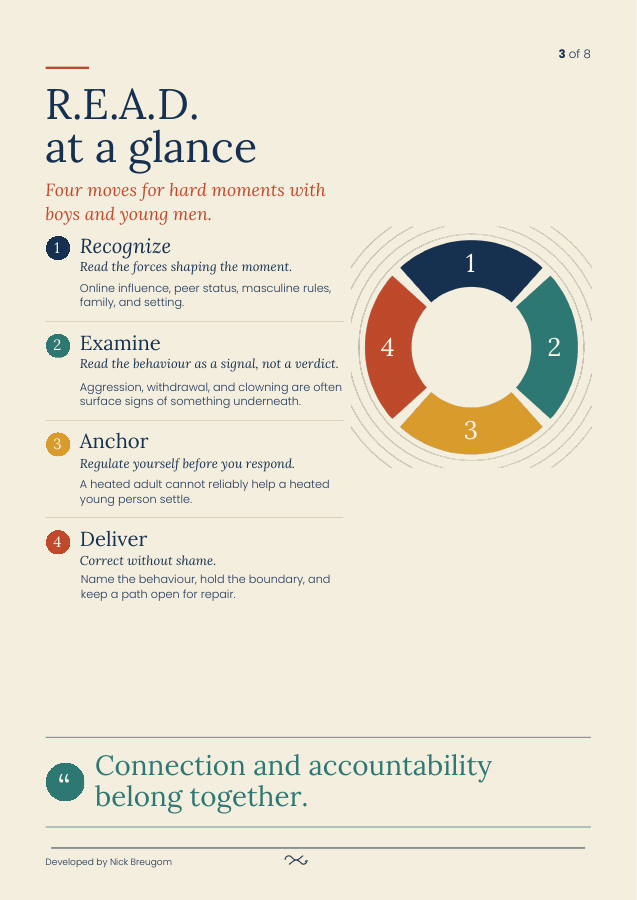
 THE COMPLETE PUBLIC BRIEF
TAKE THE FRAMEWORK WITH YOU
The complete eight-page public brief brings together the core model, accountability, a worked example, and guidance on when to use READ and when to act.
Download the full brief Open & print the PDFOpens the original PDF. Use the viewer’s print button or your browser’s Print option.
Free to use and share in full with attribution to Nick Breugom. Not for resale or modification without permission.